Table of Contents
- Your Guide to Electric Water Heater Installation in the Greater Los Angeles Area
- Electric Water Heater Installation Fundamentals
- Cost, Permits, and Timeline for Electric Water Heater Installation
- Choosing a Licensed Electrician for Your Installation
- Safety and Efficiency Optimization for Your New Water Heater
- Frequently Asked Questions About Electric Water Heater Installation
- Schedule Professional Electric Water Heater Installation in Los Angeles
Your Guide to Electric Water Heater Installation in the Greater Los Angeles Area
When you are considering an electric water heater installation in Los Angeles, having a clear understanding of the full process is essential. We have created this guide to walk homeowners through each step, ensuring you know what to expect from the initial assessment to the final inspection. For an electricians service team overview, our firm has been delivering residential solutions across communities from Echo Park to Glendale and Santa Monica with an unwavering focus on safety and code compliance.
We approach every installation by verifying that your existing electrical system is properly prepared for a dedicated water heater circuit. Our licensed, uniformed electricians follow the National Fire Protection Association’s National Electrical Code (NFPA 70) benchmarks to ensure correct branch circuit sizing, overcurrent protection, and a compliant disconnecting means. Before any work begins, we perform several essential pre-installation checks:
- Verifying your panel has adequate capacity to support a dedicated 240 V / 30 A circuit.
- Confirming local building code requirements, including seismic strapping mandated in LA County.
- Evaluating whether a water heater replacement or an upgrade to a heat pump or tankless unit will require a panel enhancement.
Understanding these technical details is why homeowners often search for a water heater repair near me and discover that a full upgrade is the safer, more efficient long-term solution. When we proceed, our electricians pull the required permits and coordinate inspections, so you never have to worry about unlicensed subcontractors or hidden fees—we provide clear, upfront, value-focused quotes for every project. This initial phase naturally transitions into the detailed load calculation we perform during your first diagnostic visit, laying the groundwork for a safe and reliable installation.
Electric Water Heater Installation Fundamentals
Before any physical water heater setup begins, an electric water heater installation requires a thorough evaluation of the home’s existing electrical infrastructure. The foundation of a safe and code-compliant setup lies not in the tank itself, but in the dedicated circuit, proper disconnect, and grounding that feed it. We understand that these behind-the-wall requirements often go unnoticed until a failure occurs, making it critical for Southern California homeowners to recognize what a professional assessment entails.
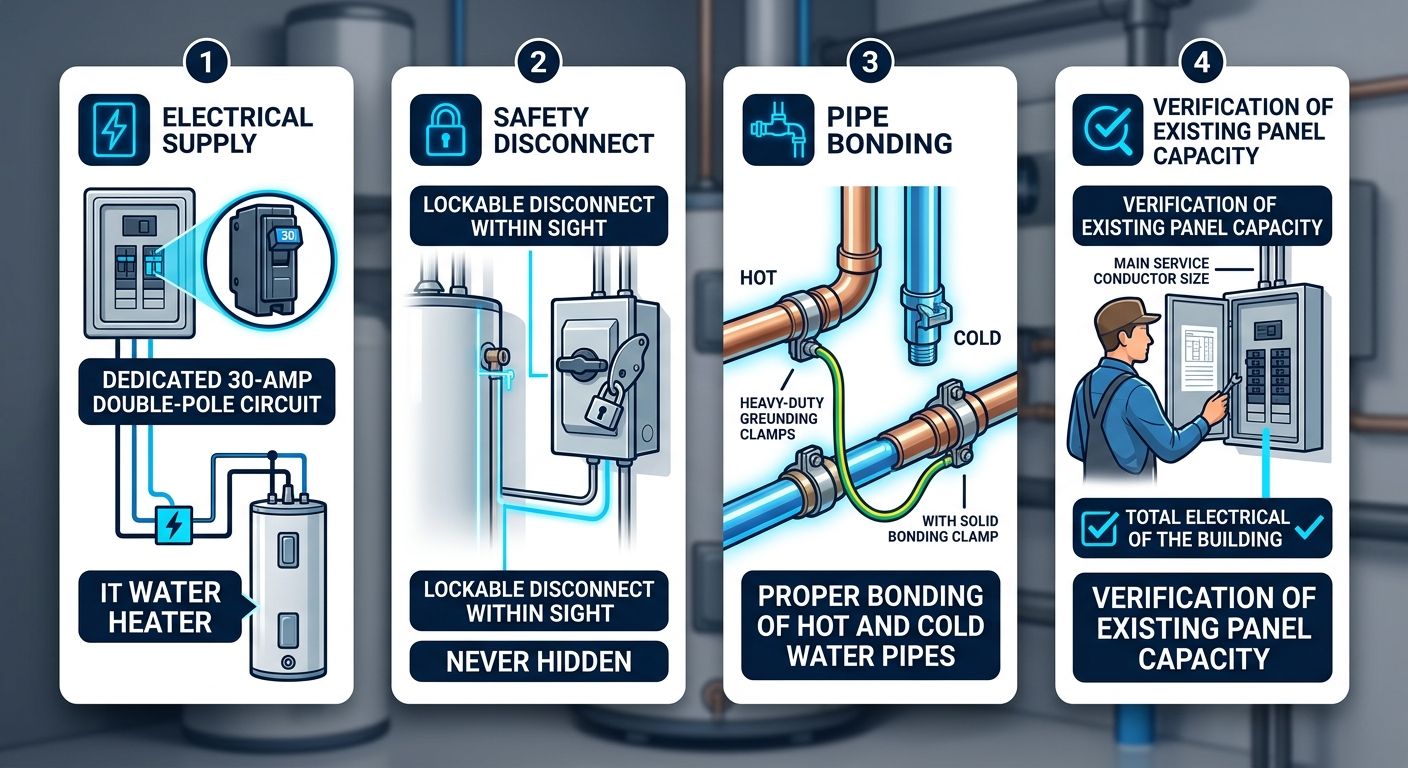
A standard residential electric water heater typically demands a dedicated 240-volt, 30-amp circuit served by a double-pole breaker and 10/2 NM copper cable. This dedicated pathway ensures the appliance does not compete with other high-draw devices, preventing nuisance tripping and potential overheating at the panel. When we perform a water heater replacement, assessing whether the existing wiring gauge matches the new unit’s specification is non-negotiable; older homes in communities from Los Angeles to Orange County often have undersized or degraded conductors that must be upgraded. Verifying the electrical panel’s total capacity is equally vital, since a heavily loaded panel may show signs like flickering lights or warm breakers, indicating that a panel upgrade is necessary before adding a new 30-amp load.
Safety codes mandate a lockable disconnect or a circuit breaker within sight of the water heater, as required by the National Electrical Code (NEC) and enforced across California jurisdictions. This disconnect allows a technician to completely de-energize the unit during maintenance or an emergency without returning to a remote panel, a detail we verify on every service call. Equally fundamental is proper bonding and grounding. We bond the hot and cold water pipes to the electrical system’s grounding conductor to eliminate any voltage potential differences and reduce shock risk. Inside the water heater’s junction box, every terminal must be torqued precisely to the manufacturer’s specification; an under-tightened conductor creates resistance, leading to arcing and a serious fire hazard, while over-tightening can strip threads and compromise the connection.
It is also essential to confirm that the home’s service delivers a true 240V supply and that phase compatibility aligns with the heater’s design, as a mismatch can damage the unit immediately upon energizing. Homeowners searching for a water heater repair near me should know that proximity to a licensed professional matters because local technicians understand both the NEC and any Southern California municipal amendments that affect disconnect placement, bonding methods, and service entrance evaluations.
Electric water heater installation fundamentals
The depth of technical coordination required underscores how a trained electrician protects both property and occupants. We apply the same meticulous approach to every dedicated appliance circuit, which is why you can explore our electrical service homepage in Southern California to understand how our team addresses the foundational load, disconnect, and grounding details before a single wire is landed.
Cost, Permits, and Timeline for Electric Water Heater Installation
After understanding the significant risks that come with ignoring professional help, it is clear that a safe and efficient upgrade requires a well-planned investment. We know that a successful electric water heater installation in Los Angeles involves balancing the budget, navigating local regulations, and setting a realistic schedule. Our team is here to guide you through every step so you know exactly what to expect.
Breaking Down Electric Water Heater Installation Cost
The final cost of an installation is influenced by far more than just the price of the unit. In Los Angeles County, a unit’s tank size and Uniform Energy Factor (UEF) rating play a major role, as a high-efficiency hybrid or heat pump model often carries a higher upfront cost than a standard electric tank. The physical location of the installation matters just as much. Replacing a water heater in a tight attic or a distant basement requires more complex plumbing and wiring modifications, which directly increases labor time. We also factor in the need for potential electrical upgrades. If your home requires a new dedicated 240-volt circuit, a 30-amp double-pole breaker, or even a full panel upgrade, these will affect the overall project budget. It is also wise to consider a power surge protection guide to safeguard your new appliance from voltage spikes, which are common in Southern California.
The following table compares three common cost scenarios, from a simple like-for-like swap to a major system overhaul, to help Los Angeles homeowners estimate their potential investment.
| Cost Factor | Basic Installation | Moderate Complexity | Major Upgrade |
|---|---|---|---|
| Unit & Materials | $400 – $800 | $600 – $1,200 | $800 – $2,000+ |
| Labor | $300 – $500 | $500 – $900 | $900 – $1,500 |
| Permits | $50 – $150 | $100 – $200 | $150 – $300 |
| Electrical Upgrades | $0 (using existing) | $200 – $800 | $800 – $3,000+ |
| Total Estimated Cost | $750 – $1,450 | $1,400 – $3,100 | $2,650 – $6,800+ |
These scenarios highlight how a straightforward water heater replacement with existing wiring sits at the lower end, while a major electrical infrastructure upgrade for a new unit can increase the investment significantly.
Permits for Electric Water Heater Installation in Los Angeles
Securing the proper permits is a critical part of the process that protects your home’s safety and resale value. In Los Angeles, the Los Angeles Department of Building and Safety (LADBS) requires a permit for water heater replacements to ensure the work meets current plumbing and electrical codes. We handle this entire process on your behalf. Our licensed electricians pull the required electrical permits and schedule any necessary inspections, so you don’t have to navigate city hall. The permit process typically involves:
- Submitting a detailed plan of the installation location, unit specifications, and circuit design.
- Coordinating an on-site inspection from a LADBS official after the work is complete to verify code compliance.
- Ensuring that seismic strapping and proper drain pan installations, which are mandatory in Southern California, are up to standard.
By managing the red tape for you, we make sure your new water heater system is legally sound and ready for safe operation from day one.
How Long Does Electric Water Heater Installation Take?
A realistic timeline helps you plan for any disruption to your hot water supply. For a straightforward water heater replacement where we swap an old electric unit for a similar new model in the same spot, the physical work usually takes between 4 and 8 hours. This covers draining the old tank, connecting the new unit to existing plumbing and electrical wiring, and filling and testing the system for leaks and proper heating.
However, the schedule can extend to one or two full days if your project involves more complicated work. Running a new 240-volt circuit from your electrical panel, installing a heavy-duty disconnect switch, or reconfiguring water lines that don’t match the new fixture will add significant time. We also build in a final testing phase to verify the water temperature, thermostat calibration, and electrical load balance before we consider the job complete.
What Size Breaker Do I Need for an Electric Water Heater?
The correct breaker size is a key safety component that we calculate with precision. The necessary amperage is determined by the water heater’s wattage divided by its voltage. As a practical example, a common 4500-watt unit running on 240 volts draws 18.75 amps (4500W ÷ 240V = 18.75A). Per the National Electrical Code (NEC), a circuit’s continuous load must not exceed 80% of the breaker’s rating. This means the 18.75-amp draw requires a 25-amp or 30-amp breaker, connected with 10 AWG wire.
Before installing a new circuit, our electricians always conduct a professional electrical safety inspection. This inspection is essential to verify that your existing panel’s capacity and wiring integrity can handle the new load without creating a dangerous fire hazard. It also helps identify whether the breaker tripping you’ve experienced is a simple overload that necessitates a repair rather than a full-blown installation. In many cases, what seems like a need for a replacement is actually a localized issue that a water heater repair near me service can resolve quickly. By understanding these technical requirements, you can rest assured that your new system is built on a foundation of code-compliant safety.
Choosing a Licensed Electrician for Your Installation
When hot water fails in your Southern California home, quick decisions matter, but they must also be informed choices that protect your safety and property. This section guides you through the practical decisions involving a licensed electrician for your electric water heater needs, from installation to repair and replacement.
Can a Licensed Electrician Install an Electric Water Heater?
Yes, a licensed electrician is not just recommended but required to install an electric water heater in Los Angeles or Orange County. This work involves connecting a dedicated 240V circuit and a double-pole breaker, tasks that demand strict compliance with CEC and NFPA 70 safety codes. An electric water heater installation demands specific electrical knowledge: load calculation for a 4500W or 5500W element, assessment of your service panel capacity (which may require a 200A panel upgrade in older homes), and verification of proper grounding and bonding per Article 422 of the NEC. Furthermore, while a plumbing permit may also be necessary, the core regulated and most hazardous task is the electrical connection. Our technicians follow these national fire protection association safety standards on every job; contact our team for a free diagnostic to ensure your panel is ready.
Electric Water Heater Installation vs. Water Heater Repair
Deciding whether to repair or replace hinges significantly on the age of your unit. If your water heater is under six years old and the issue is a failed thermostat, a burnt-out heating element, or a tripped high-limit switch, a repair is typically the most cost-effective and sensible path. These are common, isolated component failures that a qualified professional can resolve, often on the same day. Conversely, if the tank is over ten years old and is leaking from the tank body itself rather than a loose fitting, repair is never advisable. A tank leak signifies imminent catastrophic failure, which can lead to extensive flooding damage, especially in the many Southern California homes built on slab-on-grade foundations. In such cases, scheduling an installation for a new, energy-efficient unit is the only safe and logical decision.
Water Heater Replacement: When Is It the Better Option?
A water heater replacement is the better option when your current unit shows clear signs of failure. The first and most urgent trigger sign is active tank corrosion or visible water pooling around the base, indicating an internal breach. The second critical sign is when the unit can no longer meet the peak morning demand of a household of four, suggesting it is either severely undersized for your needs or filled with performance-robbing sediment. The third sign is a purely financial one: when the unit’s annual energy cost surpasses what a new ENERGY STAR heat-pump water heater would cost to operate, the upgrade essentially becomes self-funding within three to four years through vital LADWP or SCE rebate programs. Recognizing these signs early prevents emergency failures and long-term water damage. We serve because we care about you and your family, and seeing these signs tells us a new electric water heater installation is the right path forward; schedule a free estimate with our team today.
Finding the Right Water Heater Repair Service Near Me
When you need a water heater repair near me in Los Angeles, vetting potential electricians with the right questions separates a qualified specialist from a general handyman. Before scheduling any service, ask these four critical questions: First, “Are you a C-10 licensed electrical contractor in California?” This confirms their legal authorization. Second, “Do you carry general liability insurance and workers’ compensation?” This protects you and your property. Third, “How many electric water heater installs have you completed in the past month?” Specific experience matters. And fourth, “Do you offer same-day or next-day emergency service with a free on-site diagnostic?” A “yes” to all four indicates you are dealing with a serious, professional electrical service. For any water heater replacement, these vetting standards are equally essential, as the project’s complexity far exceeds a simple hot water tank repair in Los Angeles. We provide exceptional electrical services backed by the right answers to all these questions, so contact us for your next repair or installation.
Installation vs. Repair: Decision-Making Guide
A clear comparison helps you weigh the most cost-effective path forward for your home.
| Decision Factor | Repair Existing Heater | Install New Heater |
|---|---|---|
| Typical Cost (LA Metro) | $150 – $600 | $750 – $6,800 |
| Average Lifespan Gained | 1-3 years | 8-12+ years |
| Energy Efficiency | Remains low/moderate | High (modern standards) |
| Disruption | Same-day fix | 3-8 hours |
| Best For | Units < 6 years old | Older or leaking units |
Data sourced from ENERGY STAR® water heater guidance and Los Angeles Department of Building and Safety permit fee schedules.
For a leak-prone unit or one that simply can’t keep up, the long-term value of a modern installation far outweighs the temporary relief of another repair. With a clearer sense of the financial and practical considerations, the final logical step is to understand exactly what the costs will be for your specific situation.
Safety and Efficiency Optimization for Your New Water Heater
Essential Safety Measures for Code Compliance
We prioritize safety above all else during water heater commissioning. One of the most critical steps is having our licensed professionals verify the electrical circuit. For a standard 30-amp unit, this means confirming that the dedicated circuit is connected with the correct wire gauge, typically 10 AWG, as mandated by the National Electrical Code. Relying on an undersized wire is a significant fire risk that professional inspection prevents. We also strongly recommend setting the thermostat to 120°F. This temperature effectively kills harmful bacteria while preventing severe scalding injuries and reducing standby heat loss, which improves energy efficiency. Furthermore, for homes with a backflow preventer or a closed plumbing system to protect the municipal water supply in Los Angeles, we must install an expansion tank. Without one, thermal expansion can generate excessive pressure that damages the tank, voids warranties, and creates a hazardous failure point.
Maintenance and Efficiency Enhancements
Once your new unit is safely installed, simple maintenance routines dramatically extend its lifespan and maintain peak efficiency. When considering a water heater replacement for an aging model, these benefits are built into modern designs, but are easily maintained with proactive care. We instruct homeowners to flush about a gallon of water from the tank’s drain valve every six months to remove sediment buildup. Accumulated sediment insulates the water from the heating element, forcing the unit to work harder and creating popping noises that signal inefficiency. For units located in unconditioned spaces like a chilly basement or garage, a focused insulation blanket can cut heat loss. Our technicians ensure these blankets are installed safely, never obstructing the thermostat access panel, the blow-off valve, or the top of an oil-fired unit. Crucially, we schedule an annual inspection starting in year two to check the anode rod. This sacrificial component prevents the tank from rusting internally; if it’s fully corroded, a quick water heater repair near me can replace it before the steel tank itself is compromised, potentially adding years to the unit’s useful life.
By following these structured optimization steps, we help you secure the efficiency and safety of your investment. Our technicians ensure that every component, from the wiring to the anode rod, performs exactly as designed, providing your family with reliable hot water while minimizing electrical and plumbing risks.
Frequently Asked Questions About Electric Water Heater Installation
Do I need a licensed electrician to install an electric water heater?
Absolutely. Electric water heaters require dedicated circuits with correctly sized wiring and breakers to meet local code. Manufacturers typically require licensed installation for warranty validity. Improper wire sizing or breaker selection creates serious fire hazards, making professional installation the only safe choice for Southern California homes.
How long does electric water heater installation take?
A standard electric water heater installation usually takes three to six hours depending on the complexity of the existing electrical setup. If the installation requires a new dedicated circuit or panel modifications, the timeline may extend. Our team works efficiently to complete the electrical portion while coordinating with the plumbing contractor on your schedule.
Will my electrical panel support a new electric water heater?
Electric water heaters often require 30-amp double-pole breakers, and older panels may lack adequate capacity. During our initial assessment, our licensed electricians perform load calculations to determine whether your panel supports the addition. If an electric panel upgrade proves necessary, we handle that before the water heater installation proceeds.
What permits are required for water heater installation in my city?
Most Los Angeles and Orange County municipalities mandate electrical permits for new circuit installations, along with final inspection sign-off. We manage the entire permitting process for you, from application submission through scheduling the inspection. This ensures your installation is fully code-compliant without you navigating bureaucratic requirements alone.
How do I know if I need a water heater repair or a full replacement?
If your unit is over ten years old, shows signs of corrosion, or needs frequent water heater repair for failing elements or thermostats, a professional electric water heater installation for a new unit is usually more cost-effective. For newer heaters with a single failed component, targeted repair makes sense. Our electricians can inspect the unit and help you evaluate the best path forward.
Can I use hot water immediately after installation?
The tank must fill completely and the electric water heater install must undergo temperature setpoint verification before use. This process typically takes about an hour after installation, but if municipal inspection is pending, you may need to wait for sign-off before full operation. Our team walks you through exactly what to expect at every step.
How long does an electric water heater last?
A professionally installed electric water heater typically lasts between 10 and 15 years depending on water quality and maintenance. Hard water conditions in parts of Los Angeles County can shorten that range, making periodic maintenance valuable. If your unit approaches this range and requires increasingly frequent repairs, replacement may be the wiser investment.
If you are still weighing your options, reach out to our team to confirm exactly what your project would require. We look forward to helping you make the right choice for your home and family.
Schedule Professional Electric Water Heater Installation in Los Angeles
Ready to enjoy efficient, reliable hot water? When you choose our team for your electric water heater installation, you’re not just getting a licensed electrician—you’re getting a neighbor committed to your family’s safety. We provide exceptional electrical services and perform the critical load calculations and dedicated circuit work required for a safe, code-compliant setup. If you’re replacing an old gas unit, our technicians manage the entire conversion, ensuring a seamless water heater replacement for your home.
We serve because we care about you and your family! Before your upgrade, our team recommends a comprehensive home electrical safety inspection to confirm your panel is ready for the new high-efficiency unit. Should any issues arise, we’re your local solution for a water heater repair near me to get the project back on track. As a locally owned team serving all of Los Angeles and Orange County, we make the process simple.
Don’t wait. Schedule Your Service! Visit our website today to book your assessment and let our family protect yours.
This article was researched and written with the assistance of AI tools.
Resources
- Comprehensive Electricians Service Company in Southern California
- Find Expert Electrical Services for Your Home
- Protect Your Home from Hidden Power Surges
- Discover the Benefits of Regular Home Electrical Inspections
- Know the Signs You Need an Electric Panel Upgrade
- Get Expert Residential Electrical Services for Safety
- Schedule Your Essential Home Electrical System Inspection
- Learn About NFPA Fire and Electrical Safety Standards