
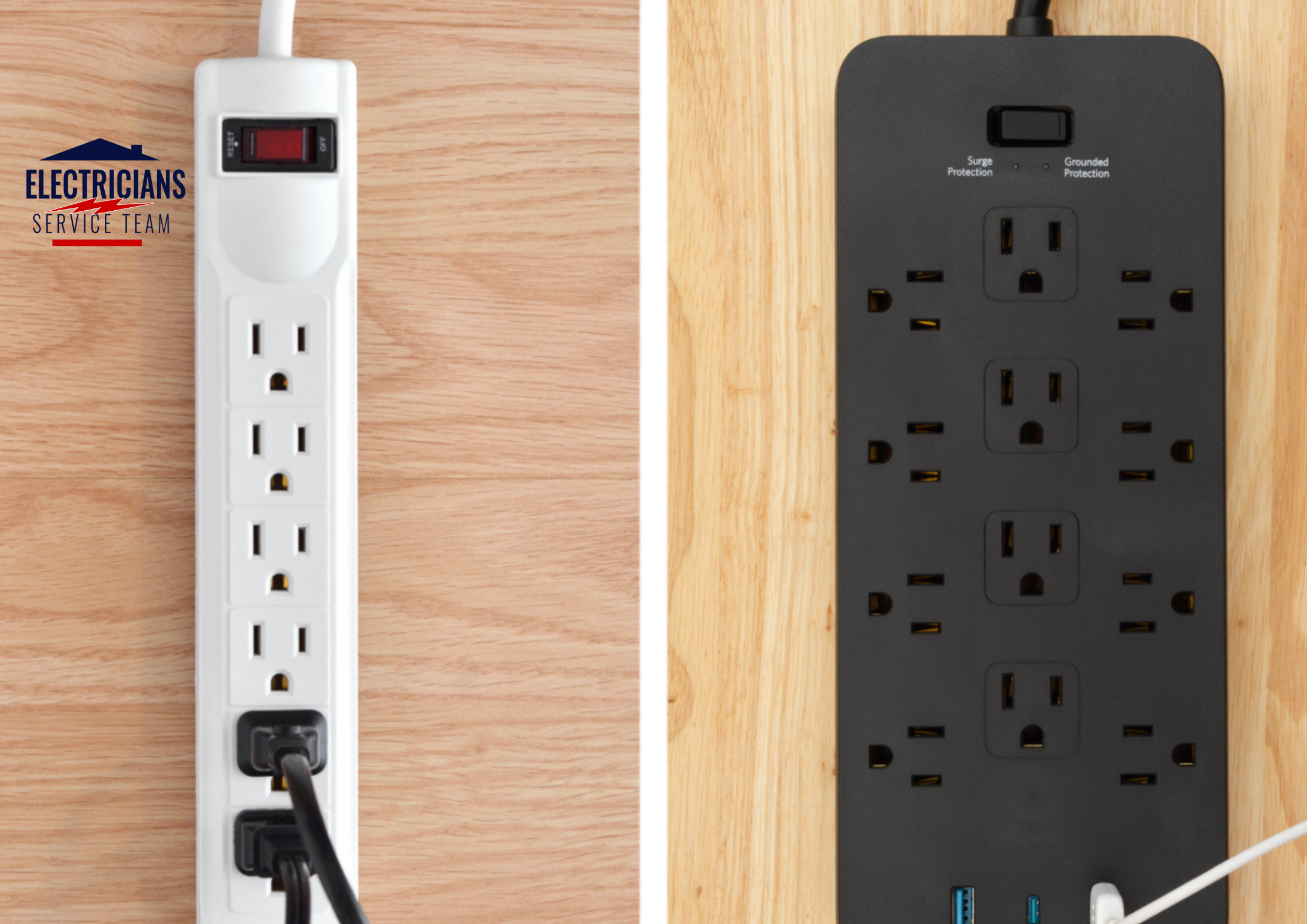
Most homeowners assume plugging electronics into a power strip is enough protection from power surges. But here’s the truth: most power strips offer little to no real surge protection. And even the ones that do are no match for the kind of voltage spike that can wipe out your appliances or destroy thousands of dollars worth of electronics in a fraction of a second.
This guide breaks down the real differences between the two — what each one does, what it doesn’t, and which one your home actually needs.
What Is a Power Surge?
A power surge is a sudden spike in electrical voltage above the normal 120 volts your home runs on. Even a millisecond of extreme voltage is enough to damage or destroy sensitive electronics.
Common causes include:
- Lightning strikes near or on your home
- Utility companies switching between grids
- Large appliances like AC units cycling on and off
- Faulty or aging wiring inside your home
Surprisingly, up to 80% of surges originate inside your own home from large appliances cycling on and off — which is why point-of-use protection alone is never enough.
Power Strip Surge Protectors: What They Are and What They Miss
A basic power strip is simply a multi-outlet extension cord — it provides zero surge protection. Some power strips include a built-in surge protection component called a metal oxide varistor (MOV) that absorbs excess voltage, but they come with serious limitations.
What they do well:
- Protect individual devices plugged directly into them
- Affordable and easy to use ($15 – $50)
- Great for desks, entertainment centers, and home offices
What they don’t do:
- Protect hard-wired appliances like your HVAC, water heater, or dryer
- Handle large lightning-induced surges without being overwhelmed
- Warn you when they stop working — MOVs degrade silently after each surge absorbed
That last point is critical. Many homeowners are using “surge protectors” that stopped protecting their devices months ago with no idea.
Whole House Surge Protectors: Full Home Coverage
A whole house surge protector installs directly into your main electrical panel by a licensed electrician. It protects every circuit, outlet, and hard-wired appliance in your home simultaneously by diverting excess voltage safely to ground before it ever reaches your wiring or devices.
What they do well:
- Protect every outlet and appliance in your entire home
- Handle far larger surge events than any power strip
- Guard against both external and internal surges
- Include indicator lights so you always know protection is active
- Last 10+ years
Cost: $150 – $300 for the device, plus $100 – $200 for professional installation — roughly $250 – $500 total.
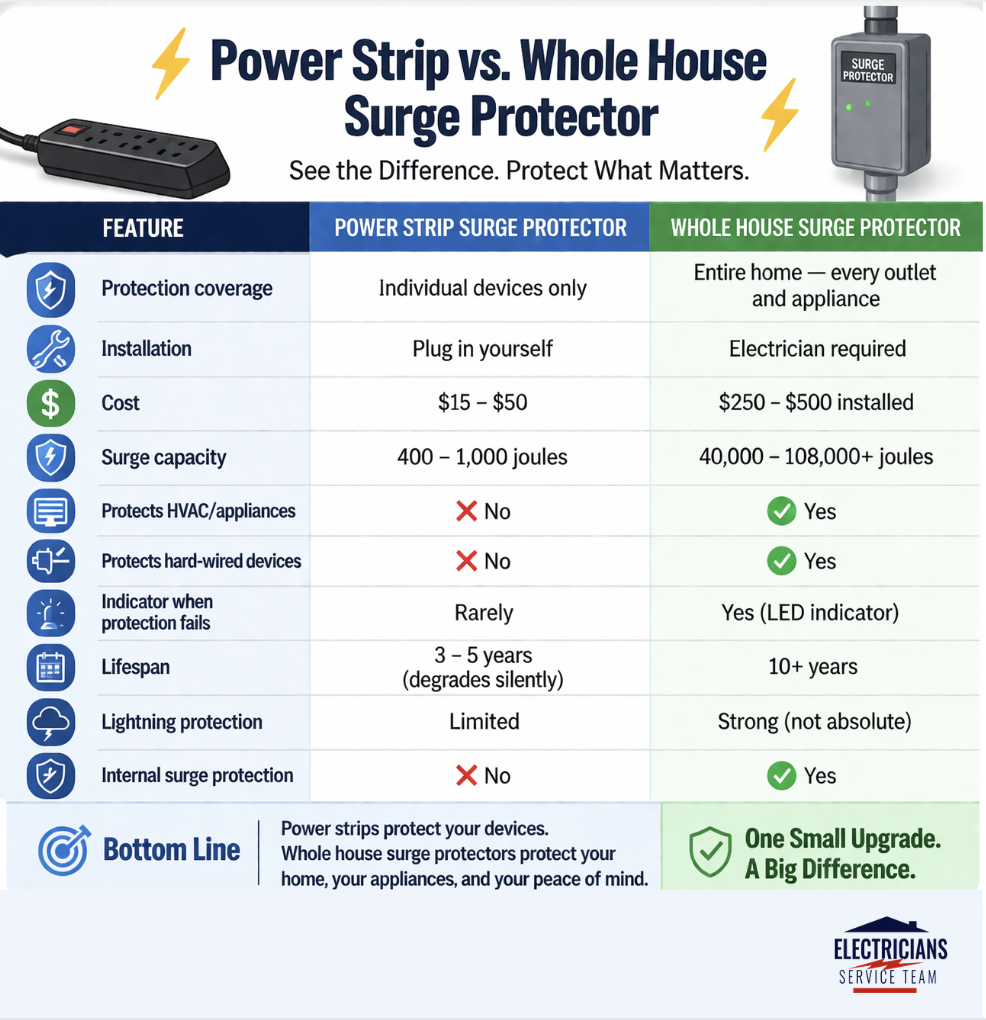
Side-by-Side Comparison
What a Power Strip Simply Cannot Protect
No matter how good your power strip is, it cannot protect these common home systems:
- HVAC system — Hard-wired directly into your electrical panel
- Refrigerator and freezer — Often on a dedicated outlet far from any strip
- Washer and dryer — 240-volt hard-wired appliances
- Electric water heater — Completely hard-wired
- Garage door opener, smart switches, security systems
Replacing an HVAC system alone costs $5,000 – $12,000. A whole house surge protector at $300 – $500 installed is one of the smartest investments a homeowner can make.
Do You Need Both?
Yes — and the reason is simple. A whole house protector stops large surges at the panel, but small residual voltage can still reach your outlets. For sensitive electronics like computers, TVs, and gaming consoles, a quality power strip provides a valuable second line of defense.
Think of it as a two-layer system:
- Layer 1 — Whole house surge protector: Blocks large surges at the source
- Layer 2 — Quality surge protector strips: Catches residual voltage at your most sensitive devices
Together, these two layers give you the most complete protection available for any home.
What to Look For When Buying
For power strip surge protectors:
- Joule rating of 1,000 or higher
- UL 1449 listed
- Indicator light confirming active protection
- Trusted brands: APC, Tripp Lite, Belkin, Leviton
For whole house surge protectors:
- Type 2 classification (most common for residential)
- Surge current rating of 40,000 amps or higher
- UL 1449 listed
- LED indicator lights and audible alarm
- Trusted brands: Siemens, Square D, Leviton, Eaton
Conclusion
A $20 power strip under your desk is not protecting your home — it’s protecting one outlet. A whole house surge protector installed at your main panel is the only way to cover everything at once: your HVAC, appliances, hard-wired devices, and every outlet in every room.
Use both layers. Invest in a whole house surge protector, back it up with quality strips at your most sensitive devices, and you’ll have the strongest protection your home can have.
FAQs
Very minimally. Lightning-induced surges carry millions of joules — far beyond what any power strip can handle. A whole house surge protector significantly reduces the damage, though no device can guarantee full protection against a direct strike.
Check the indicator light labeled “Protected.” If it’s off or showing a warning, the internal MOV has failed and the strip is no longer offering surge protection — even though it still works as a power strip.
No. This requires working inside your main electrical panel, which is extremely dangerous. Always hire a licensed electrician.
Absolutely. One surge event can destroy your HVAC, refrigerator, washer, dryer, and electronics at the same time. A $300 – $500 investment protects everything in your home at once.
Typically 10 or more years, with indicator lights that alert you when protection has been compromised and replacement is needed.