Your breaker box — also called the consumer unit or electrical panel — is the heart of your home’s electrical system. It controls every circuit in the building and protects your wiring from dangerous overloads. Most homeowners never think about it until something goes wrong.
The problem is that when something goes wrong with a breaker box, the consequences can be severe. Outdated or failing electrical panels are one of the leading causes of house fires in the UK and US. The warning signs are usually there well in advance — you just need to know what to look for.
Here’s what every homeowner should know.
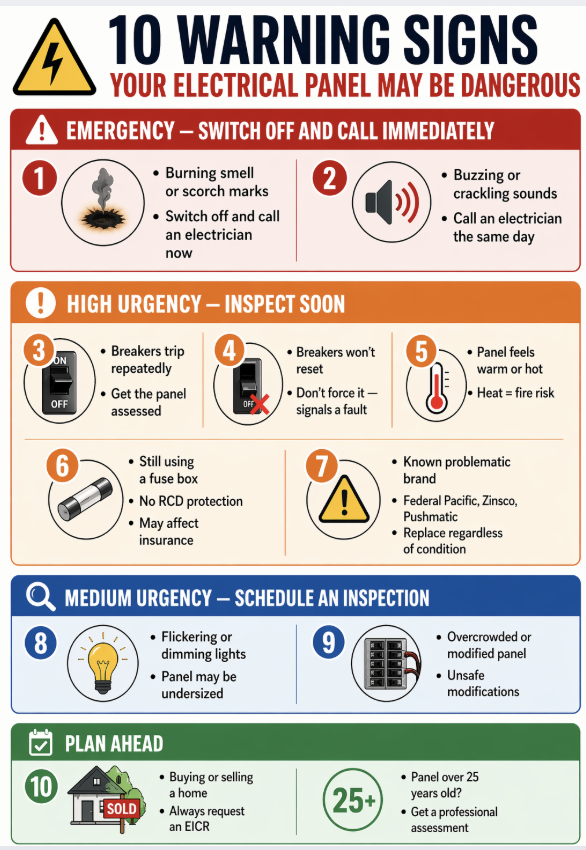
How Long Does a Breaker Box Last?
A well-installed consumer unit in good condition typically lasts 25–40 years. However, age alone isn’t the only factor. Overloading, poor installation, moisture exposure, and certain panel brands with known design flaws can make a panel dangerous long before it reaches old age.
If your home is more than 25 years old and the panel has never been replaced or inspected, it warrants a professional assessment — regardless of whether you’re experiencing obvious problems.
Warning Sign 1: Breakers That Trip Frequently
A circuit breaker that trips occasionally is doing its job. A breaker that trips repeatedly — especially under normal household loads — is telling you something is wrong.
What it could mean: The circuit is consistently overloaded, the breaker itself is worn out and tripping at a lower threshold than it should, or there’s a fault somewhere in the wiring on that circuit.
Why it matters: A breaker that no longer trips reliably is arguably more dangerous than one that trips too often. If the protective mechanism fails, an overloaded circuit can overheat and ignite surrounding materials.
What to do: Have an electrician assess whether the issue is the individual breaker, the circuit load, or a sign of wider panel deterioration.
Warning Sign 2: Breakers That Won't Reset
After a breaker trips, it should reset with a firm click and hold its position. If a breaker refuses to reset, resets but immediately trips again, or sits in a middle position between on and off, the breaker or the circuit it protects has a serious fault.
Never force a breaker that won’t reset. This is a sign of an active fault on the circuit — forcing it risks electrical arc, fire, or electrocution. Leave it off and call a licensed electrician.
Warning Sign 3: Burning Smell or Scorch Marks
A burning smell — particularly one that resembles hot plastic or burning rubber — coming from your consumer unit is a critical warning sign. Similarly, any scorch marks, discolouration, or melted plastic around breakers or the panel casing means heat has already built up to dangerous levels.
This is an emergency. If you notice a burning smell from your electrical panel, switch off the main breaker and contact a licensed electrician immediately. Do not ignore it or assume it will resolve on its own.
Warning Sign 4: A Buzzing, Crackling, or Sizzling Sound
Your breaker box should be completely silent during normal operation. Any audible buzzing, crackling, hissing, or sizzling sound is abnormal and potentially dangerous.
What causes it: Loose connections, a failing breaker, or arcing electricity between components. Electrical arcing is one of the primary causes of electrical fires — it can ignite surrounding insulation and materials at temperatures exceeding 3,000°C before any breaker has a chance to trip.
What to do: Turn off the main breaker and call an electrician the same day. Do not investigate the sounds yourself by opening the panel.
Warning Sign 5: Flickering or Dimming Lights
Lights that flicker or dim briefly when an appliance starts up — a washing machine, air conditioner, or refrigerator compressor — can indicate that your panel is struggling to handle the electrical demand of your home.
When it’s a serious concern: If flickering is frequent, affects multiple circuits simultaneously, or occurs without any obvious trigger, it may point to a loose main connection, failing breakers, or a panel that is simply undersized for your household’s current electrical load.
Modern homes use significantly more electricity than homes built 30 or 40 years ago. A panel installed in the 1980s or 1990s was likely rated for a much lower load than your household now demands.
Warning Sign 6: The Panel Feels Warm or Hot to the Touch
The outer casing of your consumer unit should be at or close to room temperature at all times. If the panel feels noticeably warm — and especially if it feels hot — heat is building up inside due to overloaded circuits, loose connections, or failing components.
Heat is a precursor to fire. A panel that runs warm is dissipating energy it should be routing safely through your circuits. Don’t wait to have this inspected.
Warning Sign 7: You Still Have a Fuse Box
If your home has an older fuse box rather than a modern consumer unit with circuit breakers, replacement isn’t just advisable — it’s strongly recommended by electrical safety organisations and may be required by your insurer.
Why fuse boxes are a risk: Old-style rewirable fuses can be incorrectly repaired with wire that has the wrong rating, removing the protection they’re supposed to provide. They also lack the Residual Current Device (RCD) protection that modern consumer units include — RCDs cut power in milliseconds when they detect a fault, and are proven to save lives.
Insurance implications: Many UK home insurers now require a modern consumer unit as a condition of cover. An outdated fuse box may invalidate your policy in the event of an electrical fire.
Warning Sign 8: Your Home Has Had Electrical Work Added Over the Years
Extensions, new kitchens, home offices, EV chargers, hot tubs — any significant electrical addition puts more demand on your panel. If your home has had multiple rounds of electrical work added to an ageing panel, the original unit may no longer be appropriately rated or safely configured for the current load.
What to look for: A panel that looks overcrowded, has double-tapped breakers (two wires connected to a single breaker terminal), or has breakers that don’t match the original panel brand are all signs that the installation has been compromised over time.
Warning Sign 9: Known Problematic Panel Brands
Certain electrical panel brands manufactured in the mid-to-late 20th century have well-documented safety issues and have been the subject of recalls and safety warnings. If your panel is made by Federal Pacific Electric (Stab-Lok), Zinsco, or Pushmatic, replacement is strongly recommended regardless of its apparent condition — these panels have a known history of failing to trip under fault conditions.
In the UK: Older split-load consumer units without full RCD protection, or any unit manufactured before the 17th Edition wiring regulations, should be evaluated for upgrade.
Warning Sign 10: You're Buying or Selling a Home
A home electrical inspection is standard practice in property transactions, and an outdated or defective consumer unit will be flagged by any competent surveyor or inspector. Replacing the panel before listing can protect your sale price and prevent last-minute renegotiations.
If you’re buying a home, always request an electrical installation condition report (EICR) and take a failing panel seriously — it’s not a minor cosmetic issue.
What Happens If You Ignore These Warning Signs?
Electrical faults develop gradually and then suddenly. A panel that has been running warm, buzzing quietly, or tripping intermittently for months can deteriorate to the point of arc fault or fire without obvious escalation. Electrical fires are particularly dangerous because they frequently start inside walls — well out of sight — before they become visible.
The cost of a new consumer unit (typically £500–£1,500 fully installed in the UK, or $1,500–$3,000 in the US) is a fraction of the cost of fire damage, insurance complications, or the unthinkable human cost of a house fire.
FAQs
In the UK, a full consumer unit replacement typically costs £500–£1,500 depending on property size and installation complexity. In the US, expect $1,500–$3,000. It’s a one-time investment that protects your home for the next 30–40 years.
No — and in most countries it’s illegal without a licence. The main supply cables remain live even with the main breaker off, posing a risk of fatal electrocution. In England and Wales this work must be carried out by a Part P registered electrician.
Most residential consumer unit replacements take 4–8 hours and are completed in a single day. Your power will be off for the duration of the work.
An Electrical Installation Condition Report is a full inspection of your home’s electrical system by a qualified electrician. Recommended every 10 years for owner-occupied homes and every 5 years for rental properties — it will flag any consumer unit issues alongside the wider installation.
Not necessarily. A single tripping circuit could be an overloaded circuit, a faulty appliance, or a worn individual breaker. However, a service call is a good opportunity to have the whole panel checked at the same time.