Your TV suddenly stops working. Your router dies for no obvious reason. Your fridge compressor fails years before it should. You assume bad luck. You buy a replacement and move on.
What actually happened? A power surge — and there’s a very good chance it will happen again.
Most homeowners think power surges are rare dramatic events caused by lightning strikes. The reality is far more unsettling: the majority of power surges happen inside your own home, silently and repeatedly, every single day. They’re too small to trip a breaker or blow a fuse, but cumulatively they degrade sensitive electronics until one day a device simply stops working.
Here’s everything you need to know — and exactly what to do about it.
What Is a Power Surge?
Your home runs at a consistent voltage — 230V in the UK, 120V in the US. A power surge is any spike above that, even for a nanosecond. That’s too fast for a circuit breaker to catch, but more than enough to damage the sensitive microelectronics inside modern devices.
The damage isn’t always instant. Powerful surges kill devices outright. Smaller repeated surges — the kind that happen in most homes daily — degrade components slowly until one day a device simply stops working.
What Actually Causes Power Surges?
Lightning gets the blame, but it causes a small minority of surges. The real culprits are far more ordinary:
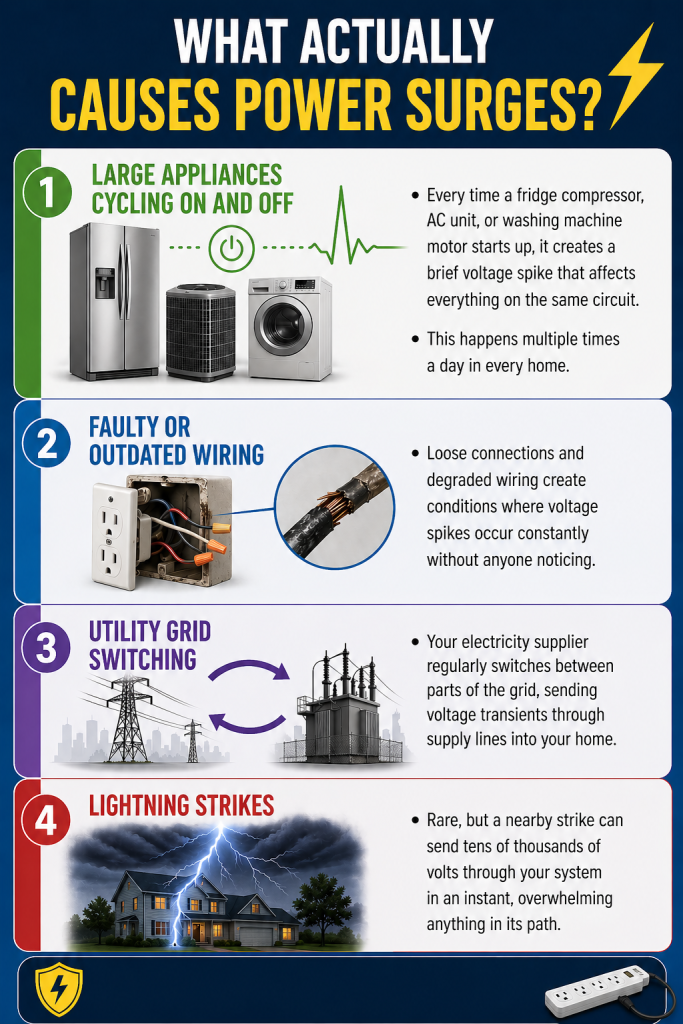
Large appliances cycling on and off — every time a fridge compressor, AC unit, or washing machine motor starts up, it creates a brief voltage spike that affects everything on the same circuit. This happens multiple times a day in every home.
Faulty or outdated wiring — loose connections and degraded wiring create conditions where voltage spikes occur constantly without anyone noticing.
Utility grid switching — your electricity supplier regularly switches between parts of the grid, sending voltage transients through supply lines into your home.
Lightning strikes — rare, but a nearby strike can send tens of thousands of volts through your system in an instant, overwhelming anything in its path.
Which Devices Are Most at Risk?
The more electronics a device contains, the more vulnerable it is.
High risk: Smart TVs, computers, gaming consoles, routers, home theatre systems, and any device with a circuit board or digital display.
Often overlooked: Modern fridges and washing machines with electronic control boards, EV chargers, solar inverters, and smart home systems — all expensive to replace and frequently unprotected.
A basic kettle with a mechanical switch is virtually immune. A smart fridge with a Wi-Fi connected touchscreen is not.
The Two Layers of Surge Protection
This is where most homeowners go wrong — a cheap power strip is not enough. Real protection works in two layers.
Layer 1 — Whole-home SPD (Surge Protection Device) Installed inside your consumer unit by a qualified electrician, a whole-home SPD intercepts large external surges before they reach any circuit in your home. Without this, a significant surge bypasses every plug-in protector in the house simultaneously. Cost fitted: £150–£400.
Layer 2 — Point-of-use surge protectors Plug-in surge protector strips handle smaller internal surges from your own appliances. When buying one, look for a Joule rating above 1,000J, a clamping voltage of 400V or lower, and an indicator light confirming protection is still active. When the light goes off, replace it — even if it still powers your devices.
Do You Need Both?
Yes — because neither layer alone covers everything.
A whole-home SPD handles large external surges but doesn’t suppress the smaller daily surges from your own appliances. Point-of-use protectors handle those smaller surges but are completely overwhelmed by a large external spike. Together they cover the full spectrum of risk — the same principle as wearing a seatbelt and having airbags.
Signs Your Home May Have a Surge Problem
Most surges go unnoticed, but these are warning signs:
Devices failing earlier than their expected lifespan. LED bulbs burning out unusually quickly. Frequent need to reset routers or digital clocks after nothing obvious happened. Lights flickering when large appliances start up. Outlets that feel warm or have a faint burning smell.
If several of these apply, your wiring may be contributing to the problem — an electrical inspection is worth considering.
If your home has an older fuse box rather than a modern consumer unit with circuit breakers, replacement isn’t just advisable — it’s strongly recommended by electrical safety organisations and may be required by your insurer.
Why fuse boxes are a risk: Old-style rewirable fuses can be incorrectly repaired with wire that has the wrong rating, removing the protection they’re supposed to provide. They also lack the Residual Current Device (RCD) protection that modern consumer units include — RCDs cut power in milliseconds when they detect a fault, and are proven to save lives.
Insurance implications: Many UK home insurers now require a modern consumer unit as a condition of cover. An outdated fuse box may invalidate your policy in the event of an electrical fire.
FAQs
Yes. Plug-in protectors handle small internal surges but are overwhelmed by large external ones. Only a whole-home SPD at the consumer unit can stop a major surge before it reaches your circuits.
Check the indicator light. If it’s off but the strip still provides power, the protection has been used up and needs replacing — it’s no longer offering any defence.
Yes — if they’re still plugged in. As long as a device is connected to the mains it’s exposed. Unplugging during a thunderstorm is the only guarantee of zero exposure.
No. A UPS includes surge protection but also provides battery backup during a power outage. For general home device protection a quality surge protector is sufficient — a UPS is worth considering for home offices or medical equipment.
It depends on your policy. Most cover sudden surge damage but exclude gradual degradation from repeated small surges — which is precisely how most damage occurs. Check your policy wording carefully.