
Table of Contents
- Navigating California's ADU Electrical Code Landscape
- California ADU Electrical Code Fundamentals
- Exploring 2026 Title 24 Requirements for ADU Electrical Systems in California
- Practical ADU Electrical Planning and Cost Considerations in California
- Advanced ADU Load Calculations and Solar Mandates in California
- Frequently Asked Questions About ADU Electrical Codes in California
- Ensuring Your ADU Electrical Project is Code-Compliant in California
Navigating California’s ADU Electrical Code Landscape
When planning an accessory dwelling unit, understanding the electrical code requirements for adu california is the critical first step for homeowners in Los Angeles, Orange County, and surrounding areas. California’s ADU boom has prompted many homeowners across Greater Los Angeles to take on new construction or garage conversions, making code compliance a timely and practical concern. As a locally owned and operated electrical contractor serving the region, we’ve seen firsthand how important it is to get ADU electrical work right from the very beginning.
This guide walks through California’s ADU electrical code fundamentals, local amendments, permitting expectations, and when an electrical panel or service upgrade becomes necessary. In fact, our recent article on reasons to upgrade your home electrical system details the warning signs — outdated panels, flickering lights, and frequent breaker trips — that often signal an ADU addition will exceed existing capacity. Understanding these requirements up front helps homeowners avoid expensive rework, delays, and failed inspections. That’s why enlisting an experienced ADU electrical contractor is often the smartest move for a smooth, code-compliant installation. Partnering with a qualified electrician early in your project helps streamline the permitting process and ensures your new living space is safe and fully functional.
Let’s start with the fundamentals of California’s ADU electrical code.
California ADU Electrical Code Fundamentals
Under the California Electrical Code (CEC), an ADU is a separate dwelling unit with its own load calculations, protection rules, and permit path. Getting these fundamentals right up front helps the project pass inspections smoothly.
Governing Code and Load Calculations. An ADU is a separate dwelling under the CEC, so it demands its own load calculation. General lighting goes in at 3 VA per square foot, plus small-appliance, laundry, and HVAC loads.
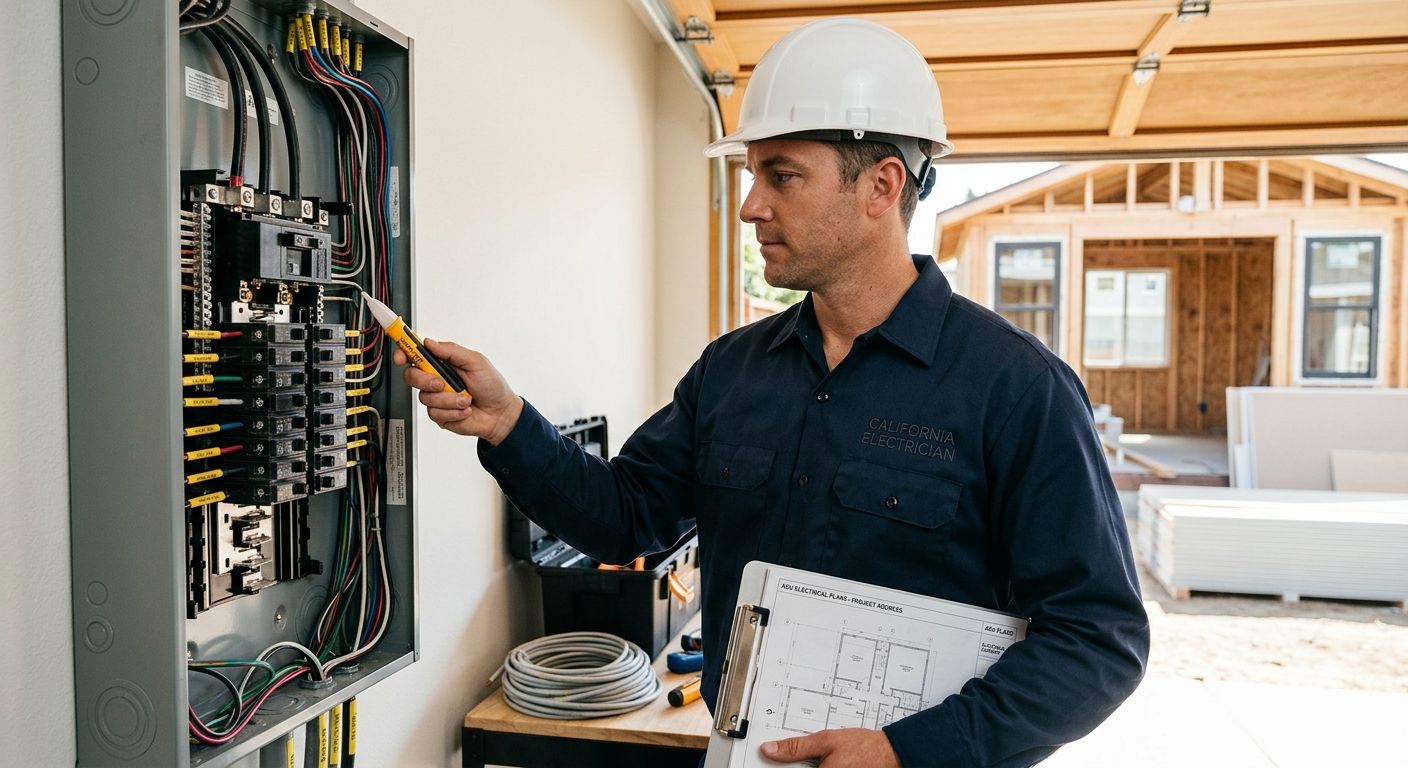
Panel Capacity. In many Los Angeles homes, the existing 100-amp panel can’t handle an added ADU; a service upgrade to 200 amps or a sub-panel is frequently required. Our electricians perform full load evaluations and coordinate upgrades with your utility and city inspectors.
| Aspect | Standard Residential | ADU Requirements |
|---|---|---|
| Governing Code | CEC with local amendments; standard permit path. | Same CEC; treated as separate dwelling, triggering independent permits and inspections. |
| Service/Panel Capacity | Original panel sized for house; 100 A common in older LA homes. | Combined main+ADU loads usually over 100 A; upgrade or sub-panel required. |
| Load Calculation | One dwelling-unit calc for lighting, appliances, HVAC. | Separate ADU calc plus combined total; 3 VA/sq ft lighting, appliance circuits, laundry, HVAC. |
| Permits & Inspections | Permit may be required; inspections if pulled. | Full plan review, electrical permit, rough-in/final inspections by AHJ before energizing. |
Our field teams have seen that capacity and load-calculation surprises are the most frequent causes of ADU electrical delays. By evaluating the combined service load and specifying the right panel early—before any wire is pulled—homeowners can keep the entire permit-to-energize timeline on track.
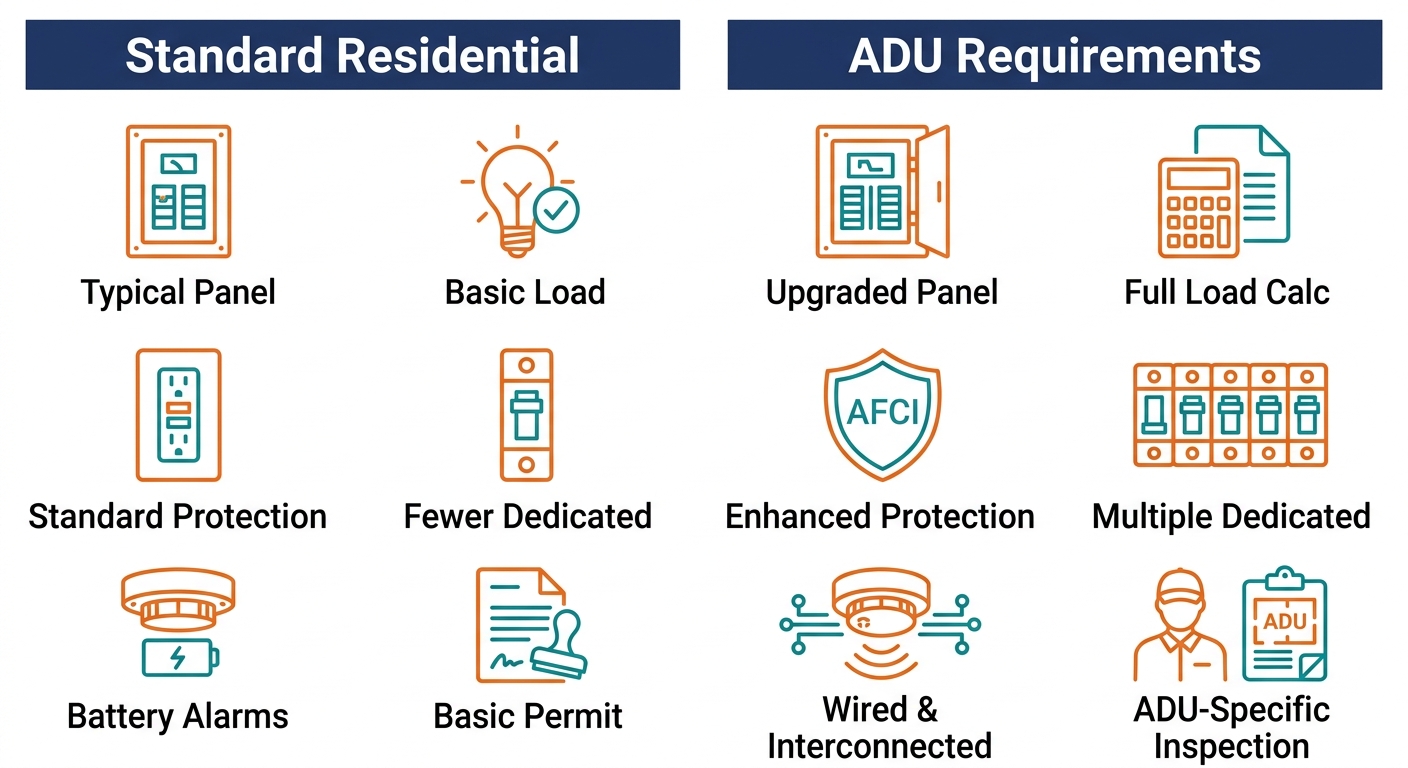
Protection Devices and Permits. ADU circuits in living and sleeping rooms need AFCI protection, while bathrooms, kitchens, and outdoors need GFCI. Dedicated circuits serve major kitchen appliances, and a laundry circuit is required if the ADU includes a washer and dryer. Before the system can be energized, the local authority having jurisdiction—such as the Los Angeles Department of Building and Safety—must approve plans and pass rough-in and final inspections. Smoke and carbon monoxide alarms must be interconnected and code-powered, and egress lighting must meet the building code. Our technicians are trained to California codes, and we provide exceptional electrical services that help you pass inspection on the first visit.
Once you understand these foundational requirements, the upcoming 2026 Title 24 changes become easier to digest.
Exploring 2026 Title 24 Requirements for ADU Electrical Systems in California
Building on the foundational electrical code requirements for accessory dwelling units in California, this section examines how the 2026 Title 24 standards (California Energy Code, Part 6) advance those fundamentals. The focus is on energy efficiency, load calculation, electric-ready design, and grid-interactive technology — all of which shape the electrical work required when constructing or upgrading an ADU.
Understanding Title 24 Energy Efficiency Standards for ADUs
Title 24, Part 6 applies to every newly constructed ADU in California and mandates baseline energy-efficiency measures that directly affect electrical planning. The code requires specific insulation levels for ceilings and walls, which reduce heating and cooling loads and shrink the electrical demand of HVAC equipment. High-efficacy lighting — essentially LED fixtures — must be installed throughout the ADU, paired with occupancy or vacancy sensors and manual-on/automatic-off controls to eliminate wasteful energy use.
HVAC systems installed in an ADU must meet minimum efficiency ratings set by Title 24. By improving the building envelope and lighting efficiency first, the code keeps the mechanical and electrical loads as low as practical, which in turn helps homeowners avoid unnecessary panel or service upgrades. In our work across Los Angeles, we have found that a code-compliant ADU envelope consistently pays dividends in comfort, lower energy bills, and long-term home value.
Key Electrical Load Calculation Requirements
Before adding an ADU, the California Electrical Code (based on NEC Article 220 with state amendments) requires a load calculation to verify that the existing electrical service can safely carry the new loads. A full calculation follows a structured process:
- Determine the total connected load of every appliance, lighting circuit, and receptacle planned for the ADU.
- Apply the prescribed demand factors — allowances that recognize not all loads operate simultaneously.
- Compare the adjusted load against the existing service capacity (typically 100 A, 125 A, or 200 A).
- When the calculated demand exceeds the service rating, a panel or service upgrade becomes necessary.
Most older 100-amp panels cannot absorb the additional demand from even a modest ADU. A 200-amp service upgrade is the common remedy — one that our licensed electricians have successfully performed for countless ADU projects throughout our service area. This upgrade not only meets code but also positions the property for future additions such as an electric vehicle charger or a heat pump, aligning with the proposed 2026 requirements.
2026 Proposed Changes and Grid-Ready Provisions
While the 2022 standards are in force, the California Energy Commission has published draft proposals for 2026 that, if adopted, will further shape ADU electrical work. The proposals include an electric-ready provision that would require a dedicated 240-volt circuit and outlet near the electrical panel, reserved for a future electric vehicle charger. Additionally, the draft rulemaking points toward a heat pump mandate for both space heating and water heating, effectively eliminating gas-fired equipment from new ADUs.
Grid-interactive measures are expected to be introduced as well. Under the proposed language, new electric water heaters would need to be grid-interactive, capable of adjusting their power draw in response to utility signals. These provisions are clearly marked as “proposed” and subject to change before final adoption, but we encourage homeowners planning an ADU to consider them now as a form of future-proofing their investment.
As these proposed requirements come into sharper focus, homeowners and contractors alike begin translating them into the practical planning and cost decisions that the next section addresses.
Practical ADU Electrical Planning and Cost Considerations in California
Beyond the code requirements covered in our discussion of Title 24, the practical side of ADU electrical work comes down to budgeting, service capacity, and metering choices. Every decision you make about panel location, trenching, and metering must also satisfy the electrical code requirements for ADU in California.
Budgeting for ADU Electrical Infrastructure
Electrical infrastructure costs for an ADU fall into a handful of predictable categories, but the total always depends on the specifics of your site and project size.
- Underground service run and trenching – Trenching is the largest variable line item, with typical rates of $50–$100+ per linear foot. The total cost is driven by distance from the main panel, soil conditions, and the burial depth required by code (usually 18–24 inches for direct-burial or conduit).
- Subpanel installation – Installing a dedicated subpanel for the ADU is a cost-efficient choice when the existing main panel has spare breaker slots and adequate bus capacity. Your electrician will factor in the length and size of the feeder wire, the number of circuits needed, and the subpanel’s amperage rating.
- Main panel upgrade – Upgrading the main service panel becomes necessary when the combined load of the ADU and the existing home exceeds the current panel’s rating, or when the panel is outdated.
- Permits and inspection fees – City permit costs differ across municipalities, but they are a required part of any ADU electrical job.
When the electrical backbone is done right the first time, the project moves forward more smoothly and helps maintain our record of 100% satisfied clients.
Subpanel vs Main Panel Upgrade: Decision Factors
The decision between a subpanel and a full main panel upgrade starts with a load calculation. Your electrician will sum all continuous loads in the ADU, add the largest motor loads (such as a mini-split heat pump), and compare the total to the existing service capacity. The existing main panel must also be checked for spare breaker slots and enough bus capacity to accept a new feeder for the ADU subpanel.
Several warning signs indicate an existing panel is undersized or outdated: an inability to keep up with demand, a lack of spare breaker slots, breakers that trip frequently, or an older panel design that may not meet modern safety standards. When the calculated ADU load plus the home’s current load exceeds the main panel’s rated capacity, or when one of these warning signs is present, a full main panel upgrade is typically the right call. In other cases, installing a subpanel off the existing service is the cost-efficient choice that still meets code and provides reliable power to the ADU.
Separate Metering in Los Angeles: Rules and Rationale
In Los Angeles, LADWP typically allows separate metering for ADUs, and many municipal utilities follow a similar approach. A separate meter is often used in rental scenarios because it makes tenant billing straightforward and keeps the ADU’s electrical costs independent from the primary residence. Before finalizing your metering strategy, verify the rules with your local municipal utility or Authority Having Jurisdiction, because meter types, service connection fees, and specific requirements vary by city and utility.
Once the budget and panel strategy are clear, the next step is ADU Load Calculations and Solar Mandates in California, which walks through sizing the system and accounting for any solar requirements.
Advanced ADU Load Calculations and Solar Mandates in California
After covering planning and cost considerations, we move into the technical calculations and regulatory rules that determine whether an ADU project requires an electrical service upgrade.
NEC 220.82 provides the optional method for calculating an ADU’s electrical load. We start with 3 VA per square foot for general lighting, then add 1,500 VA for each small-appliance branch circuit and 1,500 VA for the laundry circuit. We apply the demand factors — 100% of the first 10 kVA plus 40% of the remainder — the ADU’s calculated load. We add that ADU load to the existing dwelling load to decide whether a 100-amp or 200-amp service can carry the combined demand. If the combined load exceeds the panel’s capacity, a service or panel upgrade is required.
When new construction triggers California’s energy code, Section 110.10 (Title 24, Part 6) requires solar PV for new residential construction, with limited ADU exemptions. Detached ADUs 800 square feet or less that add no new electrical load are exempt, as are ADUs served entirely by the existing service with no increase in demand. Where the solar requirement does apply under the current code, the installation must also include battery storage.
| ADU Type | Solar Mandatory? | Exceptions/Conditions | Key Notes |
|---|---|---|---|
| Detached ADU over 800 sq ft | Yes | No exception once new service is added | Solar PV plus battery storage applies |
| Detached small ADU (800 sq ft or less) | No | Exempt as a small ADU | Confirm no new load is added |
| Attached ADU | Depends | Treated as an addition to the primary dwelling | Solar triggered when project thresholds are met |
| ADU with no new electrical load | No | Served by existing service | Verify capacity with load calculation |
These load-calculation mechanics and solar-mandate exceptions clarify when an electrical upgrade is required and lead into the homeowner questions in the next FAQ section.
Frequently Asked Questions About ADU Electrical Codes in California
After reviewing load calculations and solar mandates, homeowners wonder about the electrical code requirements for ADU in California.
Do I need a permit for the electrical work on an ADU in California?
Yes, most ADU electrical work needs a permit. The California Electrical Code requires inspections for new circuits, panel upgrades, and wiring.
What does an ADU electrical inspection involve?
An inspector verifies that wiring, grounding, and panel work meets code and matches the approved plans.
Does adding an ADU require a panel upgrade?
Yes; an ADU can push a panel beyond capacity. We recommend an upgrade or sub-panel to manage added circuits.
How do California’s solar mandates affect ADU electrical requirements?
New ADUs typically must include solar panels or other energy measures, which can affect panel sizing and load calculations.
Ensuring Your ADU Electrical Project is Code-Compliant in California
Meeting the electrical code requirements for an ADU in California requires proper permitting, inspections, and compliance with the California Electrical Code and Title 24. A licensed electrician familiar with Los Angeles and Orange County departments is essential. Adding an ADU often triggers a main panel upgrade; our guide on reasons to upgrade your electrical system explains what to watch for. If you’re uncertain about your panel’s capacity, we offer a free diagnostic visit to assess your setup—call us at (800) 568-8664 or request an appointment online.
Ensure Your ADU Electrical Compliance
You’ve explored the complete picture of electrical code requirements for an ADU in California, from Title 24 mandates to advanced load calculations. Now that you understand the fundamentals—including when a panel upgrade is necessary and how solar mandates apply—the next step is putting this knowledge into action with a professional assessment. A licensed electrician can evaluate your current electrical panel capacity and determine whether you need a 200-amp service upgrade to safely support your new accessory dwelling unit. Our team has extensive experience with ADU electrical projects across Los Angeles and Orange County, handling everything from permitting to final inspection. We ensure your project meets all California Electrical Code and local building department requirements, so you avoid costly rework and delays. Schedule a consultation today to get a clear plan for your ADU’s electrical system and move forward with confidence.