Table of Contents
- When Your Circuit Breaker Just Won’t Stay On
- Understanding Why Your Circuit Breaker Keeps Tripping
- Benefits of Addressing a Tripping Breaker Early
- How a Circuit Breaker Works and How to Reset It Safely
- Best Practices for Preventing Circuit Breaker Tripping
- Your Trusted Partner for Circuit Breaker Safety in Los Angeles
When Your Circuit Breaker Just Won’t Stay On
When a circuit breaker keeps tripping and refuses to stay in the ON position, it’s a clear signal that something in your electrical system needs attention. We recommend starting with one simple, safe step: unplug every device and appliance connected to that circuit, then try resetting the breaker a single time. If the breaker now holds with nothing plugged in, you’re likely dealing with an overloaded circuit. From there, plug each item back in one at a time. A heavy appliance like a refrigerator or space heater can draw enough power on its own to cause a dedicated circuit to trip repeatedly.
If the breaker continues to trip the moment you reset it—even with everything unplugged—the cause may be a short circuit. In plain language, a short circuit is a low-resistance path that lets a dangerous surge of current flow, forcing the breaker to shut off for safety. Follow these circuit breaker troubleshooting steps to isolate the problem before calling us.
We serve because we care about you and your family, so please never force a breaker to stay on or hold it in place—that action can create a serious electrical fire hazard. A breaker that trips instantly under no load is a serious issue that must be inspected by a licensed professional. For a full investigation, see our faulty circuit breaker guide and let our team perform a safe, thorough diagnosis.
With over a decade of experience serving Los Angeles, Electricians Service Team stands ready to handle precisely these situations. We provide exceptional electrical services and strive to leave every client 100% satisfied. When a breaker ceases to reset, reaching out for expert circuit breaker repair is the safest way to protect your home.
Understanding Why Your Circuit Breaker Keeps Tripping
A circuit breaker is your home’s first line of defense against electrical hazards, automatically shutting off power when it detects an unsafe condition. If your circuit breaker keeps tripping, it’s not just an inconvenience—it’s a clear signal that something in your electrical system needs attention. Understanding the root cause can help you determine whether it’s a simple fix or a situation that requires professional service. The three main reasons a breaker trips are an overloaded circuit, a short circuit, and a ground fault. Each has distinct causes, warning signs, and safety implications that every homeowner should recognize.
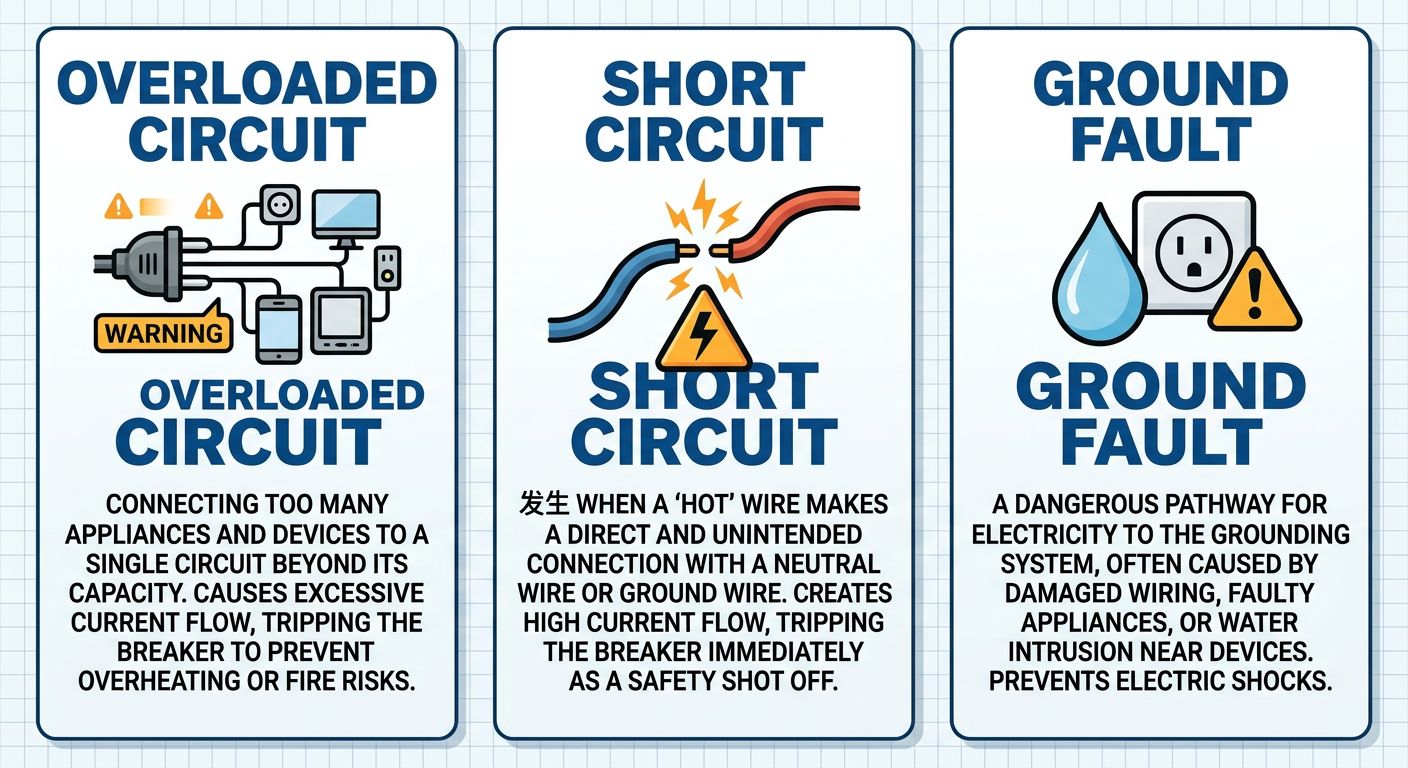
Visual guide to common causes of circuit breaker tripping.
Overloaded Circuit: The Most Common Culprit
An overloaded circuit happens when the total amperage drawn by all connected devices exceeds the circuit’s rating. For example, running a 1500W space heater on a 15-amp kitchen circuit already powering a refrigerator and lights will almost certainly cause the breaker to trip. This is a common scenario, especially in older homes where fewer circuits serve multiple rooms. When the electrical demand surpasses the safe limit, the breaker trips to prevent overheating wires and potential fire hazards.
Typical signs of an overloaded circuit include flickering lights when major appliances cycle on, warm or vibrating outlet covers, and a humming or buzzing sound coming from the breaker panel. If the issue resolves after unplugging a few devices and resetting the breaker, you’ve likely identified an overload situation. Our team often finds that redistributing high-wattage appliances across different circuits is an effective first step in resolving these recurring trips.
Short Circuit: When Wires Touch Unintentionally
A short circuit occurs when a hot wire comes into direct contact with a neutral wire, creating a sudden, massive surge of current. This surge generates intense heat almost instantly, which is why the breaker trips immediately to prevent fire or severe damage to the electrical system. According to our experience at Electricians Service Team, short circuits are often the result of damaged insulation, loose connections inside an outlet box, or wiring that has been pierced by a nail or screw during home renovations.
The signs of a short circuit are often unmistakable. You may notice a distinct burning smell near an outlet or switch, or see visible blackening or scorch marks on the wall plate. Sometimes the breaker will trip the very moment you plug in a device, pointing to a fault within the appliance or the receptacle itself. Because a short circuit indicates a genuine wiring fault, it must be addressed immediately by a licensed electrician to eliminate the severe fire risk it represents.
Ground Fault: How Moisture and Wiring Meet
A ground fault occurs when a hot wire touches a grounded surface, such as a metal electrical box, a copper pipe, or even a damp section of a wall. This creates an unintended path for electricity to flow to the ground, bypassing the normal circuit resistance. Ground faults are particularly common in areas where moisture is present, such as kitchens, bathrooms, basements, and outdoor outlets. Even high humidity can contribute to the conditions that allow a ground fault to develop.
Modern building codes require GFCI (Ground Fault Circuit Interrupter) outlets in these vulnerable areas specifically to guard against this hazard. A GFCI outlet monitors the flow of current and shuts off power in milliseconds if it detects a leak to ground, often tripping faster than the main breaker. While pressing the reset button on a GFCI outlet might restore power temporarily, recurring ground fault trips indicate a persistent moisture issue or faulty wiring that needs professional evaluation. If you suspect any of these issues, schedule a circuit breaker repair service with us so our licensed technicians can perform a thorough, safe diagnosis.
Benefits of Addressing a Tripping Breaker Early
Now that you know why breakers trip, let’s explore the benefits of addressing the issue promptly. If your circuit breaker keeps tripping, treating it as a minor inconvenience rather than a warning sign can lead to costly consequences. At Electricians Service Team, we emphasize that early professional intervention is the most effective way to protect your Los Angeles home and family from preventable electrical dangers.
Preventing Fire Hazards and Electrical Shock
A persistently tripping breaker is your electrical system’s primary distress signal. It often indicates a dangerous fault, such as a short circuit or ground fault, where electricity is flowing along an unintended path. This abnormal flow generates intense heat, which can melt wire insulation and ignite surrounding materials, putting your home at serious risk. According to the Occupational Safety and Health Administration (OSHA), strict workplace regulations exist to prevent exactly these kinds of electrical hazards, a standard we believe should extend to every home. Only a licensed electrician can safely trace these hidden faults and perform the necessary repairs to eliminate the risk of fire and electrical shock. We provide exceptional electrical services to ensure your safety.
Protecting Your Appliances and Electronics
Beyond the immediate fire risk, ignoring frequent tripping can silently destroy your valuable electronics and appliances. When your breaker trips, it abruptly cuts power to everything on that circuit. This sudden shutdown can damage sensitive components in computers, televisions, and smart home systems. More critically, an overloaded circuit that causes repeated tripping often subjects your refrigerator, HVAC system, or washing machine to damaging power fluctuations that degrade performance and shorten their lifespan. By having our team quickly diagnose and resolve the root cause, whether it’s a faulty wiring connection or a circuit that needs to be split, you are directly investing in the longevity of your expensive equipment. We serve because we care about you and your family, and that includes protecting the appliances your household relies on every day.
Peace of Mind and Cost Savings
Perhaps the most significant benefit of early repair is the peace of mind that comes from knowing your home is electrically sound. A breaker that trips repeatedly is a constant source of stress, disrupting your daily routine and leaving you worried about a potential emergency. Addressing the issue with a same-day repair from a licensed professional eliminates that anxiety. Financially, proactive repair is far more affordable than the emergency replacement of a fried appliance, repairing fire damage, or a complete panel change that might be needed if neglect continues. For your reassurance, our technicians are licensed and bonded, as verified by the California contractor license board. This commitment to transparency and professionalism protects your investment and ensures long-term savings. Ready to fix that tripping breaker? Our licensed electricians are here to help.
100% Satisfied Clients
We serve because we care about you and your family, and this principle guides every repair we complete. Your satisfaction is the measure of our success, driving us to deliver solutions that are not just effective, but also durable and safe. With over 600 projects documented, our team’s commitment to quality is evident in every home we serve across Los Angeles. We take the time to explain the repair, ensure you understand the work completed, and leave your home as clean as we found it. Choose a partner that treats your home like our own and join our community of 100% satisfied clients by scheduling your diagnostic visit today.
How a Circuit Breaker Works and How to Reset It Safely
When a circuit breaker keeps tripping, a home electrical system is doing exactly what it was designed to do—protecting you. The breaker’s primary job is to shut down power the moment it senses an unsafe level of current flowing through a circuit. From our work in the Los Angeles area, we know that understanding the mechanism behind the trip and following safe reset procedures are the first steps toward a reliable electrical system. The information that follows explains the internal workings of the device, walks you through a methodical reset process, and helps you recognize when it is time to bring in a professional.
The Basic Mechanism of a Circuit Breaker
Inside every standard residential breaker, two separate detection methods work together to guard your wiring. The first relies on a bimetallic strip—two thin layers of different metals bonded together. When current passes through the strip under normal conditions, the strip stays cool and straight. When too many devices draw power on the same line, the excess current heats the strip, causing the metals to expand at different rates. The strip physically bends away from the contact point, snapping the circuit open. This is the classic response to an overloaded circuit.
The second method uses an electromagnet to catch a short circuit. A short circuit occurs when a hot wire touches a neutral or ground wire, creating a sudden rush of current far higher than the circuit’s rating. The spike energizes the magnet instantly, pulling a mechanical lever that separates the contacts in milliseconds. Whether the breaker trips from heat or magnetic force, the result is the same: power stops flowing before the wires inside your walls can overheat. Because the breaker’s components react to different fault conditions, they provide layered protection for your home.
Step-by-Step Guide to Safely Reset Your Breaker
Before touching any part of the electrical panel, confirm that the floor around you is dry and that your hands are free of moisture. Safety always comes first when electricity is involved. Once you are in a dry, stable position, follow these steps in order.
Begin by turning off and unplugging every device, light, and appliance connected to the circuit that tripped. An overloaded circuit often trips because the combined draw of the devices exceeds the breaker’s capacity, and leaving equipment connected can cause an immediate re-trip. Next, open the metal door of the service panel so you can clearly see the rows of breaker switches. Locate the breaker that is sitting in the middle position or that feels spongy compared to the others.
Firmly push the switch all the way to the OFF position until you feel a solid click, then pull it fully to the ON position. You should hear a positive latching sound. If the breaker stays engaged, return to the room and plug in the largest appliance first, then add other devices one at a time. By testing the load gradually, you can identify whether a single faulty device is causing the trip. Never tape a breaker handle in place or use any method that defeats its ability to open. Doing so disables the very protection your home depends on.
When Resetting Is Not Enough
A breaker that trips once and stays reset after you redistribute the load rarely signals a serious problem. A breaker that trips again minutes later, or that trips immediately with a loud pop, is telling you something different. Repeated tripping, especially when it occurs with the same appliance or on the same outlet, often points to damaged wiring, a failing device, or a loose connection inside the panel itself. When you encounter this pattern, continuing to reset the breaker only masks a developing hazard.
Persistent tripping can also reveal a panel-level issue, such as a worn-out breaker that no longer holds its rated current or a connection that has loosened over time and generates heat. In commercial settings, our technicians also evaluate whether the installation complies with workplace safety regulations OSHA, because unaddressed electrical faults can create liability and a genuine risk of fire. Rather than experiment with multiple resets, we recommend scheduling a professional inspection. Electricians Service Team provides circuit breaker repair and safety inspections that identify the root cause of the trip, from overloaded circuits and short circuits to aging infrastructure, so your electrical system can be restored to safe working order.
A homeowner who respects the breaker’s warning and seeks qualified help at the first sign of a stubborn fault protects both property and family. Regular maintenance and prompt attention to repeated trips are the most reliable ways to keep your home’s electrical system performing correctly for years to come.
Best Practices for Preventing Circuit Breaker Tripping
Now that we understand why breakers trip, let’s explore how to prevent it. If your circuit breaker keeps tripping, you’re not alone — but there are proven ways to reduce nuisance trips. Our team at Electricians Service Team has developed practical strategies that help our Los Angeles clients maintain reliable electrical systems without constant interruptions.
Managing Electrical Load in Your Home
Avoiding an overloaded circuit is largely about spreading high-wattage appliances across separate circuits. Plugging a microwave, toaster, and coffee maker on the same kitchen circuit can easily cause an overload — we recommend spreading high-wattage appliances across two separate circuits in your kitchen. A short circuit can develop when hot and neutral wires contact each other, but everyday overloads are more common and entirely preventable through smart distribution.
If you’ve added a home office, new appliances, or an EV charger, your panel might lack the capacity. A 200-amp upgrade can eliminate chronic tripping by providing headroom for modern electrical loads. We suggest walking through your home and mapping which outlets connect to which breakers — this simple step reveals overload risks before they cause problems. Our technicians can assess your panel’s total load and recommend adjustments that match your actual usage patterns.
Scheduling Professional Inspections
We recommend biennial inspections for typical homes and annual inspections for older homes of 30 years or more, or properties with high electrical usage. During these visits, our technicians are licensed and bonded through the California contractor license board. We check for loose connections, corrosion, and ground-fault protection — not just the breakers themselves.
A licensed electrician examines panel condition, wiring age, and whether breakers show signs of overheating or wear. Frequent tripping, burning smells, rust, or a warm panel cover can indicate that your breaker box needs replacement rather than repeated repairs. According to the Electricians Service Team diagnostic guidance, these warning signs demand professional evaluation because they often point to internal arcing or failing components. Catching these issues early prevents more expensive emergency calls later.
Smart Habits for Long-Term Reliability
Everyday habits make a significant difference in electrical reliability. Unplug phone chargers and small appliances when not in use — they still draw phantom power that contributes to unnecessary load. Never plug one power strip into another; this can exceed circuit ratings quickly and create fire hazards.
We follow workplace safety regulations OSHA standards to ensure every job is hazard-free, and we encourage our clients to adopt the same safety-conscious mindset at home. Avoid running space heaters on extension cords, which are not designed to handle sustained high current. Flickering lights or warm outlets are red flags that require professional evaluation — ignoring them risks more serious electrical failures. These small adjustments in daily routine can reduce tripping and extend the life of your electrical panel.
If these measures don’t resolve the issue, it’s time to bring in a licensed electrician. Our technicians are ready to help you diagnose persistent problems and restore reliable power throughout your home.
Your Trusted Partner for Circuit Breaker Safety in Los Angeles
We know that when your circuit breaker keeps tripping, it can feel like a constant disruption to your daily life. At Electricians Service Team, we understand the frustration and safety concerns that come with a frequently tripping breaker, and we’re ready to be your trusted partner in restoring peace of mind for homeowners throughout Los Angeles and Orange County.
A breaker that trips is actually doing its job as a vital safety feature, protecting your home from dangerous electrical threats. An overloaded circuit, where too many devices demand power from a single source, is one of the most common reasons for this to happen. In other cases, a short circuit can cause a breaker to trip instantly, creating a more serious fault that should always be checked by a licensed professional. Our team approaches every situation with a focus on safety first, ensuring the core issue is resolved correctly.
That’s why we’re committed to a higher standard of care for you and your family. We provide exceptional electrical services to every home we serve, pairing local expertise with the reliability of licensed and courteous technicians. With prompt emergency service and a dedication to 100% satisfied clients, your safety is never put on hold. If your circuit breaker keeps tripping, don’t ignore the warning—reach out today and let our family serve yours. Schedule Your Service!
Resources
- Identify and Replace a Faulty Circuit Breaker
- Step-by-Step Guide to Troubleshoot Circuit Breakers
- Get Professional Circuit Breaker Repair Service
- Spot Signs Your Breaker Box Needs Replacing
- Learn How Circuit Breakers Affect Your Electricity Bill
- Find Reliable Electrician Services in Los Angeles
- Hire a Licensed Electrician in Southern California
- Verify License Through California Contractor Board
- Understand OSHA Workplace Safety Regulations